
Are You Fit to Fight?
How God chose Gideon's 300.

“Gideon and his company overcame and destroyed the mighty host of their enemies, without any other weapons than trumpets and lamps. This is agreeable to the prophecies of the Messiah, which show that the weapons by which he should overcome his enemies should not be carnal but spiritual, and particularly that it should be by the preaching of the Word.” - Jonathan Edwards
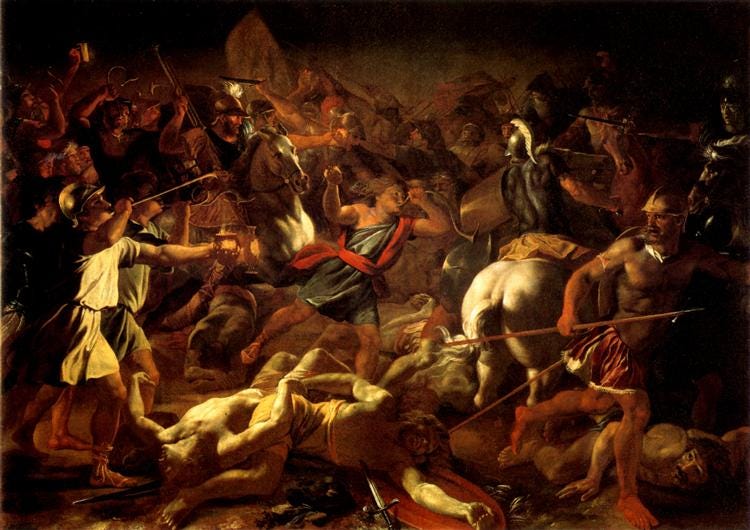
Today’s Reading: Judges 7
Accompanying Psalm: Psalm 144
SITREP: We find Israel camped at the spring of Harod, 32,000 men strong, preparing to wage war against the Midianites who oppressed them.
God knows the sinfulness of the people’s hearts, and that if it were even close to a fair fight, the people would certainly try to take credit for the victory.
And so He ties one hand behind Israel’s back, commanding Gideon to send away all the “fearful and trembling men,” allowing them to return home.
22,000 men take him up on his offer.
10,000 men remain.
But, much to the dismay of the military strategist, God is not content with this number. There are still too many men.
In the words of John Trapp, “God never complains of too few,” for His criteria for victory are often much different than ours.
And so He calls Gideon to decrease their number a second time, this time by means of a test:
So he brought the people down to the water. And the Lord said to Gideon, “Every one who laps the water with his tongue, as a dog laps, you shall set by himself. Likewise, every one who kneels down to drink.” And the number of those who lapped, putting their hands to their mouths, was 300 men, but all the rest of the people knelt down to drink water. And the Lord said to Gideon, “With the 300 men who lapped I will save you and give the Midianites into your hand, and let all the others go every man to his home.”
To lap up water like a dog was a sign of vigilance befitting a warrior.
To kneel down for a drink meant to forfeit one’s mobility and situational awareness, and so those who knelt were sent back to their homes.
300 men now remain.
Along with Gideon, these are the 300 who will take Midian.
Just before the battle, the Lord tells Gideon to conduct a sort of “leader’s recon,” in which he visits the outposts of the enemy camp and sees the Midianites and Amalekites lying in the valley like “locusts in abundance, and camels without number, as the sand that is on the seashore.”
I think it’s safe to assume that with his dwindling number of troops and his observation of the enemy’s vast size and strength, Gideon would’ve been terrified at the reality of what he was being called to do.
But then we see an occasion in which God graciously provides Gideon with a sign of His presence, strength, and omnipotence:
When Gideon came, behold, a man was telling a dream to his comrade. And he said, “Behold, I dreamed a dream, and behold, a cake of barley bread tumbled into the camp of Midian and came to the tent and struck it so that it fell and turned it upside down, so that the tent lay flat.” And his comrade answered, “This is no other than the sword of Gideon the son of Joash, a man of Israel; God has given into his hand Midian and all the camp.”
There is special significance here in this small, seemingly insignificant cake of barley bread, representing both Gideon’s lowly status and his reduced fighting force which would soon bring the Midianites to ruin, the very same people who had “robbed the Israelites of their better food and made them glad to eat barley bread” (by destroying and stealing Israel’s crops and livestock).
Again, we see that the Lord tells the best stories.
When Gideon hears about this dream, he worships, and quickly returns to his own camp (presumably now full of energy), rallying his troops:
Arise, for the Lord has given the host of Midian into your hand.
Gideon divides the 300 men into three companies, puts trumpets and empty jars in their hands, with torches inside the jars to conceal their light until the proper moment.
Gideon issues his final instructions to his army: when you hear my trumpet, then blow yours, and get ready to shout.
The army moves into position, approaching the outskirts of the camp in the beginning of the middle watch (probably between 10:00 P.M. and 2:00 A.M., so in the dead of night, when the enemy is at its most vulnerable), blowing the trumpets and smashing the jars in their hands to reveal their torches.
The fight is on.
The three companies follow Gideon’s lead, with torches in their left hands, and trumpets in their right, crying out:
“A sword for the Lord and for Gideon!”
The Midianites tuck their tails and run.
In the chaos and confusion of the trumpet blasts, the enemy army turns on itself as the Lord “sets every man’s sword against his comrade.”
The army flees as the men of Israel pursue.
Gideon sends messengers to issue a call to arms throughout the land, and more and more Israelites join the fight and pursue the Midianites.
The Israelite army seizes key terrain and captures the two princes of Midian, Oreb and Zeeb, killing them both and bringing their heads back to Gideon across the Jordan.
Gideon and his men experience complete and total victory, without ever swinging a sword.
So what does Gideon’s victory teach us about how God wages war?
Keep reading with a 7-day free trial
Subscribe to Anthropos by Lance Corporate to keep reading this post and get 7 days of free access to the full post archives.