
The Wisdom That Forms Men
Practical Wisdom for Faithful Living

“And God gave Solomon wisdom and understanding beyond measure, and breadth of mind like the sand on the seashore, so that Solomon's wisdom surpassed the wisdom of all the people of the east and all the wisdom of Egypt.” - 1 Kings 4:29
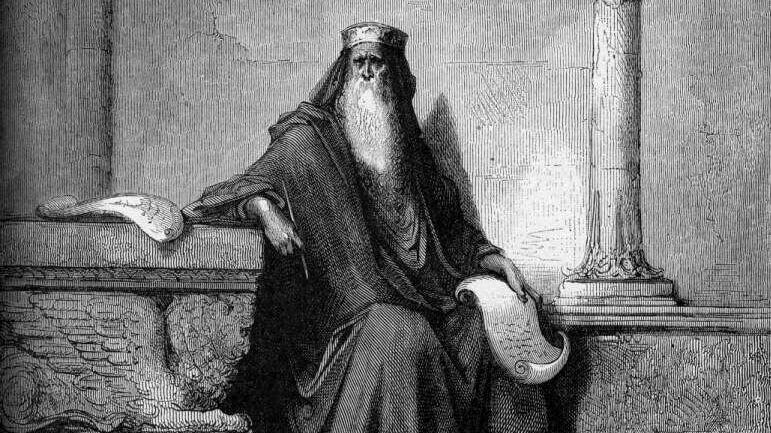
As I mentioned last week, we will start the year strong with a hard reset by considering and applying the practical wisdom found in the Proverbs.
Today, we will briefly discuss some background information on the book as a whole, starting with its author and then turning to its purpose. We will do so with some help from the 19th-century pastor and theologian Charles Bridges, whose Exposition of the Book of Proverbs is full of gems (and available online for free here).
Author
The first verse of Proverbs makes clear that its author is the great King Solomon, the Son of David and wisest of men.
In Ecclesiastes, also written by Solomon, we see that as king over Israel in Jerusalem, he “applied his heart to seek and to search out by wisdom all that is done under heaven and under the sun,” that he “acquired great wisdom, surpassing all who were over Jerusalem before him, and his heart had great experience of wisdom and knowledge.”
In other words, he’s been there, done that, and so we should listen to him.
But, says Bridges, “valuable as were Solomon’s maxims for their own wisdom (exceeding the sages of his own or any other time); they claim our reverence upon infinitely higher ground… often does he speak in the person, and always under the inspiration, of the ‘wisdom of God,’ so that his sayings are in the highest sense, ‘Divine sentences in the lips of the King.’”
Solomon is the wisest man who ever lived, yes, but it’s not his own wisdom or life experience that lends credibility to his words. Rather, it is the fact that they are the wisdom of God.
The Purpose
Bridges writes,
The great end of this inestimable book is to teach, not secular or political wisdom (though many excellent rules of each are interspersed), but that knowledge of God which, while it “maketh wise unto salvation,” perfects and furnishes the man of God unto all good works.
This is what we’re after and why we’re starting the year with Proverbs. Not just to obtain knowledge to store up in the mind, but to mine the practical wisdom that would perfect and spur us on to all good works, for it is only through action that our faith proves itself authentic. Faith without works is dead, and wisdom without application is useless.
And so in the Proverbs, we have a great treasury of useful, actionable wisdom meant to guide us on the path of righteousness unto everlasting life. Bridges says it better:
What this invaluable Book impresses upon our minds is the importance of deep-seated principles in the heart; the responsibility of conduct in every step of life; the danger of trifling deviations for expediency’s sake; the value of self-discipline; the habit of bringing everything to the Word of God; the duty of weighing in just balances a worldly and a heavenly portion, and thus deciding the momentous choice of an everlasting good before the toys of earth.
By heeding Solomon’s wisdom, we will be conformed to Christ’s image and become more self-disciplined, responsible, principled men who love and obey God and His word, who seek and demand justice, and who prioritize everlasting good over this world’s trifles.
Solomon calls this wisdom the beginning, the principal thing, of our very life, which we must seek above all else.
Finally, we acknowledge that these 31 chapters of Proverbs are a mere portion of the supposed 3,000 Proverbs uttered by Solomon throughout the course of his life on everything from wisdom and vanity to trees, birds, reptiles, and fish.
Why, we might ask, did God see fit to preserve in Scripture the Proverbs concerning practical wisdom and not the others?
Bridges again:
Possibly some would rather have desired the preservation of his discourses on Natural History than on Practical Wisdom. But this sovereign discrimination shows the real intent of the Scriptures, not to teach philosophy, but religion; not to make men of science, but men of sound godliness.
All competent judges, says Bridges, will admit this Book to be eminently fitted for this great end.
The beginning of wisdom is this: Get wisdom, and whatever you get, get insight, says Proverbs 4:7, for man is not saved by “the cedar that is in Lebanon,” nor by “the hyssop that grows out of the wall,” but by receiving God’s words and treasuring up His commandments within him.
At its core, this wisdom leads us to Him who is Wisdom personified, the Lord Jesus Christ, the “golden thread which runs through all the Bible.” To fail to see Him in all of Scripture is to attempt to “read the Scripture without the Key”:
Unquestionably, Christ is the Sun of the whole Scripture system, which reflects upon every point of practical obligation, and quickens life and energy throughout the whole Christian path. There is, therefore, much joy, comfort, and delight to be found in the writings of the Old Testament when we perceive Christ is so sweetly pictured there.
In the Proverbs, we find life-giving wisdom.
In Christ, we receive the strength to do it.
Heavenly Father, I praise You and thank You that You have not left me in the dark, but have given me Your wisdom to light the path of righteousness which leads to eternal life. Work in me a deep reverence for Your word, and a humble willingness to receive and immediately apply this wisdom to my life. Keep me from temptation and evil, and strengthen me to stay the course. In Christ’s name, Amen.
May God bless you,
T
We went through the Proverbs several years ago on this devotion.. it had a significant impact on my faith at that time. I'm really looking forward to going through them again.